RMSNorm backward (almost) without the column reduction
RMSNorm is the default by now — in an autoregressive Transformer block we see it at least twice, often four times once we count the QK norms (and the same count again in the backward pass). Both passes are memory-bandwidth-bound: there’s nowhere near enough arithmetic to hide the loads and stores behind. But backward is trickier than forward (we will see later why). I ran into this while working on the CUDA backend in MLX [1]. The idea isn’t mine — I took it from QuACK’s [2] RMSNorm backward. To see where the problem comes from, let’s look at the math.
The forward pass
Let
The forward pass seems easy: we have one reduction over each row, which can be handled quite naturally by launching one thread block per row (since hidden dim for the majority of models is <= 8192, it is covered by 1 thread block). So each thread processes multiple elements, followed by a warp-level reduction, a thread-block reduction, and finally the output write. Straightforward.
The backward pass
Now let’s look at the RMSNorm backward pass. We receive
- the gradient with respect to the weights,
; - the gradient with respect to the input,
.
Let
denote the incoming gradient after applying the gain. Then the gradient with respect to the input is (Just a little more math and it is done)
Now, the gradient with respect to the weights is
The problem: summing across rows
To compute the weight gradient we need to accumulate contributions from all
There are two ways to do this:
- use atomics to accumulate directly into the final
gradient; - write the per-row contributions to an intermediate
tensor and do a second reduction over .
The first sounds appealing: no intermediate at all. But for each of the
The naive kernel
Let’s talk about the second approach. First, we compute the per-row contributions
to the weight gradient and write the intermediate tensor
That reduction cannot be done in one pass. The output is only
rmsnorm_bwd_naive<<<M, nvec>>>(...);                     // gx + M x N partials
colsum_bf16<<<dim3(cdiv(nvec,128), NSPLIT), 128>>>(...); // M -> 64 partial rows
colsum_f32<<<cdiv(N,256), 256>>>(...);                   // 64 -> 1
Here is what the first kernel looks like in CUDA:
template <int N_READS = 8>
__global__ void rmsnorm_bwd_naive(const bf16x8* __restrict__ x,
                                  const bf16x8* __restrict__ w,
                                  const bf16x8* __restrict__ g,
                                  bf16x8* __restrict__ gx,
                                  bf16x8* __restrict__ gw, int nvec,
                                  float eps) {
  // One thread block per row: block i owns row i and nothing else, so the
  // row-wise reduction never has to leave the block.
  auto block = cg::this_thread_block();
  int row = blockIdx.x;
  int tid = threadIdx.x;
  // shared memory for the reduction: one float2 per warp
  __shared__ float2 smem[32];
  // Each thread takes one 128-bit chunk = 8 bf16 values. nvec is the row
  // length in chunks, so nvec threads cover the whole row
  size_t off = (size_t)row * nvec + tid;
  bf16x8 xv = x[off]; // input
  bf16x8 gv = g[off]; // grad
  bf16x8 wv = w[tid]; // weight

  // Two sums at once, packed into a float2:
  // .x accumulates  V_ij * X_ij -> the correction term
  // .y accumulates  X_ij^2 -> the normalizer r_i
  float2 factors = make_float2(0.f, 0.f);
// reduction within a thread
#pragma unroll
  for (int i = 0; i < N_READS; i++) {
    float t = __bfloat162float(xv.v[i]);
    // wg is V_ij = gY_ij * w_j
    float wg = __bfloat162float(wv.v[i]) * __bfloat162float(gv.v[i]);
    factors.x += wg * t;
    factors.y += t * t;
  }
  // Warp-level reduce->shared memory-> block reduce
  factors = block_sum_f2(block, factors, smem);

  int axis_size = nvec * N_READS;
  float meangwx = factors.x / axis_size;
  float normalizer = rsqrtf(factors.y / axis_size + eps);
  float normalizer3 = normalizer * normalizer * normalizer;

  bf16x8 gxv, gwv;
#pragma unroll
  for (int i = 0; i < N_READS; i++) {
    float xi = __bfloat162float(xv.v[i]);
    float wi = __bfloat162float(wv.v[i]);
    float gi = __bfloat162float(gv.v[i]);
    gxv.v[i] =
        __float2bfloat16(normalizer * wi * gi - xi * meangwx * normalizer3);
    gwv.v[i] = __float2bfloat16(gi * xi * normalizer);
  }
  gx[off] = gxv;
  gw[off] = gwv; // M x N partials for a second kernel to reduce
}
Helper: the block reduction
And some helper functions for the reduction. cg::reduce needs a scalar operator, so first a plus for our
packed pair of accumulators:
namespace cg = cooperative_groups;

struct plus_f2 {
  __device__ float2 operator()(const float2& a, const float2& b) const {
    return make_float2(a.x + b.x, a.y + b.y);
  }
};
Then the whole block reduction is two cg::reduce calls with a shared-memory hop
between them:
__device__ __forceinline__ float2
block_sum_f2(cg::thread_block& block, float2 v, float2* smem) {
  auto warp = cg::tiled_partition<32>(block);
  v = cg::reduce(warp, v, plus_f2{});
  if (warp.thread_rank() == 0) {
    smem[warp.meta_group_rank()] = v;
  }
  block.sync();
  v = warp.thread_rank() < warp.meta_group_size()
      ? smem[warp.thread_rank()]
      : make_float2(0.f, 0.f);
  v = cg::reduce(warp, v, plus_f2{});
  if (block.thread_rank() == 0) {
    smem[0] = v;
  }
  block.sync();
  return smem[0];
}
On a B200, with hidden dim 8192 and 16384 rows in bf16, this chain takes
440.54 µs and does 5 passes over the
Why this is not good enough
This works, but there is an obvious problem: we just wrote
So the goal of this post is to show how we can write the RMSNorm backward pass with only a tiny column reduction — cutting the traffic, and with it the runtime.
The persistent kernel
We want to reduce the size of the intermediate, which means the reduction across rows has to happen inside the first kernel. How can we do it? The answer is: make the kernel persistent.
In the naive version the grid is sized by the data: one block per row, so
“As many as fit” can be parsed using CUDA runtime API:
int blocks_per_sm = 1;
cudaOccupancyMaxActiveBlocksPerMultiprocessor(
    &blocks_per_sm, kernel, BLOCK_SIZE, smem_bytes);
int num_blocks = std::min<int64_t>(sm_count * blocks_per_sm, n_rows);
Each block then walks the rows in strides of num_blocks:
int64_t cur_row = bid + tile * num_blocks;Now a block sees many rows instead of one, so it can keep a running sum of its own
contribution to
But this raises a question: how do we hide the latency?
In the standard many-block scenario we get it for free. There are far more blocks than the SMs can run at once, so whenever a block stalls on a global load the warp scheduler switches to another resident warp and the SM keeps doing useful work. But a persistent kernel gives that up by construction because we launch exactly enough blocks just to fill the machine.
So now we have to hide the latency ourselves by pipelining the loads through
shared memory with the __pipeline_memcpy_async (available from
Ampere). It copies global memory straight into shared memory without
staging through registers, and (the important part) it is asynchronous.
The components:
- Allocate two buffers in shared memory, one per stage. While we compute on
stage
t % 2, the next row is landing in stage(t+1) % 2. - Prefetch the first row before the loop, then
__pipeline_commit()to close that batch of copies. - In the loop, for row
t:- issue the async copies for row
t+1into the other buffer; __pipeline_commit()to close that batch;__pipeline_wait_prior(1)to wait for rowt, but not for rowt+1;- compute on row
t, which is now sitting in shared memory.
- issue the async copies for row
In CUDA it looks like this. N_CHUNKS is how many 8-wide chunks each thread
handles along a row, so BLOCK_SIZE * N_CHUNKS * 8 = N and one block covers
exactly one row. sx and sg are the two-stage shared memory buffers, and
num_tiles is how many rows this block will end up visiting.
...
#pragma unroll
  for (int j = 0; j < N_CHUNKS; j++) {
    int off = j * BLOCK_SIZE + tid;
    if (bid < n_rows) {
      __pipeline_memcpy_async(&sx[off], &x[off], sizeof(bf16x8));
      __pipeline_memcpy_async(&sg[off], &g[off], sizeof(bf16x8));
    }
    wv[j] = w[off];
  }
  __pipeline_commit();

  for (int tile = 0; tile < num_tiles; tile++) {
    x += (size_t)NVEC * num_blocks;
    g += (size_t)NVEC * num_blocks;

    int next = tile + 1;
    int index = next % STAGES;
    int64_t next_row = (int64_t)bid + (int64_t)next * num_blocks;
    if (next < num_tiles && next_row < n_rows) {
#pragma unroll
      for (int j = 0; j < N_CHUNKS; j++) {
        int off = j * BLOCK_SIZE + tid;
        __pipeline_memcpy_async(&sx[index * NVEC + off], &x[off],
                                sizeof(bf16x8));
        __pipeline_memcpy_async(&sg[index * NVEC + off], &g[off],
                                sizeof(bf16x8));
      }
    }
    __pipeline_commit();
    __pipeline_wait_prior(1);

    // not every block gets a full complement of rows
    int64_t cur_row = (int64_t)bid + (int64_t)tile * num_blocks;
    if (cur_row < n_rows) {
      int cur = (tile % STAGES) * NVEC;  // the stage that just landed
      ....
    }
  }
The full kernel:
template <int BLOCK_SIZE, int N_CHUNKS>
__global__ void rmsnorm_bwd_pipelined(const bf16x8* __restrict__ x,
                                      const bf16x8* __restrict__ w,
                                      const bf16x8* __restrict__ g,
                                      bf16x8* __restrict__ gx,
                                      float* __restrict__ gw, int n_rows,
                                      float eps) {
  constexpr int STAGES = 2;
  constexpr int NVEC = BLOCK_SIZE * N_CHUNKS;
  constexpr int AXIS = NVEC * 8;

  auto block = cg::this_thread_block();

  __shared__ float2 smem[32];
  // dynamic: two stages each for x and g
  extern __shared__ bf16x8 sbuf[];
  bf16x8* sx = sbuf;
  bf16x8* sg = sbuf + STAGES * NVEC;

  int tid = threadIdx.x;
  int bid = blockIdx.x;
  int num_blocks = gridDim.x;
  int num_tiles = (n_rows + num_blocks - 1) / num_blocks;

  bf16x8 wv[N_CHUNKS], xv[N_CHUNKS], gv[N_CHUNKS];
  float gwb[N_CHUNKS][8];
#pragma unroll
  for (int j = 0; j < N_CHUNKS; j++) {
#pragma unroll
    for (int k = 0; k < 8; k++) {
      gwb[j][k] = 0.f;
    }
  }

  x += (size_t)NVEC * bid;
  g += (size_t)NVEC * bid;
  gx += (size_t)NVEC * bid;
  gw += (size_t)AXIS * bid;

#pragma unroll
  for (int j = 0; j < N_CHUNKS; j++) {
    int off = j * BLOCK_SIZE + tid;
    if (bid < n_rows) {
      __pipeline_memcpy_async(&sx[off], &x[off], sizeof(bf16x8));
      __pipeline_memcpy_async(&sg[off], &g[off], sizeof(bf16x8));
    }
    wv[j] = w[off];
  }
  __pipeline_commit();

  for (int tile = 0; tile < num_tiles; tile++) {
    x += (size_t)NVEC * num_blocks;
    g += (size_t)NVEC * num_blocks;

    int next = tile + 1;
    int index = next % STAGES;
    int64_t next_row = (int64_t)bid + (int64_t)next * num_blocks;
    if (next < num_tiles && next_row < n_rows) {
#pragma unroll
      for (int j = 0; j < N_CHUNKS; j++) {
        int off = j * BLOCK_SIZE + tid;
        __pipeline_memcpy_async(&sx[index * NVEC + off], &x[off],
                                sizeof(bf16x8));
        __pipeline_memcpy_async(&sg[index * NVEC + off], &g[off],
                                sizeof(bf16x8));
      }
    }
    __pipeline_commit();
    __pipeline_wait_prior(1);

    int64_t cur_row = (int64_t)bid + (int64_t)tile * num_blocks;
    if (cur_row < n_rows) {
      int cur = (tile % STAGES) * NVEC;
      float2 factors = make_float2(0.f, 0.f);
#pragma unroll
      for (int j = 0; j < N_CHUNKS; j++) {
        int off = j * BLOCK_SIZE + tid;
        xv[j] = sx[cur + off];
        gv[j] = sg[cur + off];
#pragma unroll
        for (int k = 0; k < 8; k++) {
          float t = __bfloat162float(xv[j].v[k]);
          float wg =
              __bfloat162float(wv[j].v[k]) * __bfloat162float(gv[j].v[k]);
          factors.x += wg * t;
          factors.y += t * t;
        }
      }
      factors = block_sum_f2(block, factors, smem);
      float meangwx = factors.x / AXIS;
      float normalizer = rsqrtf(factors.y / AXIS + eps);
      float normalizer3 = normalizer * normalizer * normalizer;

      bf16x8* gx_row = gx + (size_t)tile * num_blocks * NVEC;
#pragma unroll
      for (int j = 0; j < N_CHUNKS; j++) {
        int off = j * BLOCK_SIZE + tid;
        bf16x8 ov;
#pragma unroll
        for (int k = 0; k < 8; k++) {
          float xi = __bfloat162float(xv[j].v[k]);
          float wi = __bfloat162float(wv[j].v[k]);
          float gi = __bfloat162float(gv[j].v[k]);
          gwb[j][k] += gi * xi * normalizer;
          ov.v[k] =
              __float2bfloat16(normalizer * wi * gi - xi * meangwx * normalizer3);
        }
        gx_row[off] = ov;
      }
    }
  }

#pragma unroll
  for (int j = 0; j < N_CHUNKS; j++) {
    float* p = gw + (size_t)(j * BLOCK_SIZE + tid) * 8;
    f32x4 lo, hi;
#pragma unroll
    for (int k = 0; k < 4; k++) {
      lo.v[k] = gwb[j][k];
      hi.v[k] = gwb[j][k + 4];
    }
    reinterpret_cast<f32x4*>(p)[0] = lo;
    reinterpret_cast<f32x4*>(p)[1] = hi;
  }
}
Same shape as the naive version, minus the middle (M, N) reduction:
kernel<<<nb, BLOCK, smem>>>(...);
colsum_f32<<<cdiv(N,256), 256>>>(...);
Results
One B200, bf16:
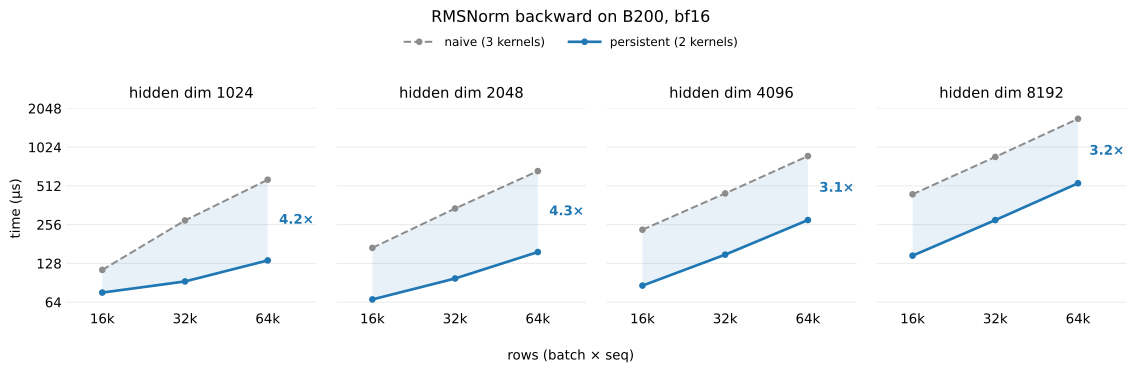
Dashed = naive (3 kernels), solid = persistent (2 kernels).
The code
Both kernels:
nvcc --generate-code=arch=compute_100a,code=sm_100a --std=c++20 \
     rmsnorm_backward.cu -o rmsnorm_backward
./rmsnorm_backward 8192 16384 # hidden dim, rows
References
[1] MLX — Apple. An array framework for machine learning on Apple silicon and CUDA. https://github.com/ml-explore/mlx
[2] QuACK — QuACK: A Quirky Assortment of CuTe Kernels https://github.com/Dao-AILab/quack